|
Aurora / Meteor Shower Images
The cycle for lows and highs of solar activity occur roughly every 11 years. Coronal Mass Ejections (CME) from sunspots are usually responsible for the geomagnetic storms which produce the Aurora Borealis displays. You never know when a sunspot might unleash an Earth directed CME! If you would like to know what's happening with Aurora activity, refer to this site: http://www.sec.noaa.gov/
The images below of the Aurora Borealis were taken from our new home in Fort Frances, Ontario, Canada (48.6 N latitude), which is located approximately halfway between Thunder Bay, Ontario and Winnipeg, Manitoba. Fort Frances is more isolated and has less light pollution than our previous home in Caledon, Ontario which was located near the light pollution of the GTA (Greater Toronto Area). Geomagnetic storms should also appear brighter in Fort Frances as it is about 4 degrees further north than Caledon. Aurora Borealis - May 7/8, 2016 This was the most powerful light show we have seen since moving to Fort Frances. It was a G3 Class geomagnetic storm and the skies were wild and full of activity in all directions. These photos were taken between 11:00 p.m. and 2:15 a.m. CDT. Photos taken with a Canon 6D with Sigma 20mm ART lens and a Canon 5D MKII with a Canon 17mm lens.
Aurora Borealis - May 1, 2016 We were having a fire in our fire pit when we noticed a green glow in the northern sky at around 10:00 p.m. CDT. The display really intensified quite quickly. Just after 10:30 p.m. the display diminished. The light pillars were very tall and reminded me of skyscrapers. Photos taken with a Canon 6D with a Sigma 20mm ART lens.
Aurora Borealis - September 9, 2015 A large arc formed during the early stages of this storm. It was amazing how slowly the arc moved and morphed across the sky. The latter part of the storm had fast moving pulses dancing across the sky. Photos taken with a Canon 6D with a 17mm lens.
Aurora Borealis - June 22, 2015 Another very powerful storm with amazing full sky aurora. Photos taken with a Canon 7D with a 8mm Sigma fisheye lens and a Canon 6D with 17mm lens.
Aurora Borealis - March 17, 2015 A very strong storm with lots of purple in the early part of the evening. Photos taken with a Canon 6D with a 17mm lens.
Aurora Borealis - February 19, 2014 Another fantastic display and unexpected! These were the brightest Aurora that I have captured in Fort Frances. There was a bright waning gibbous moon which interfered, but it was no match for the brightness of this display. The Kp index was only 6 but it seemed like a stronger geomagnetic storm. Photos taken with a Canon 5D MKII with a 17mm lens and a Sigma 8mm fisheye lens.
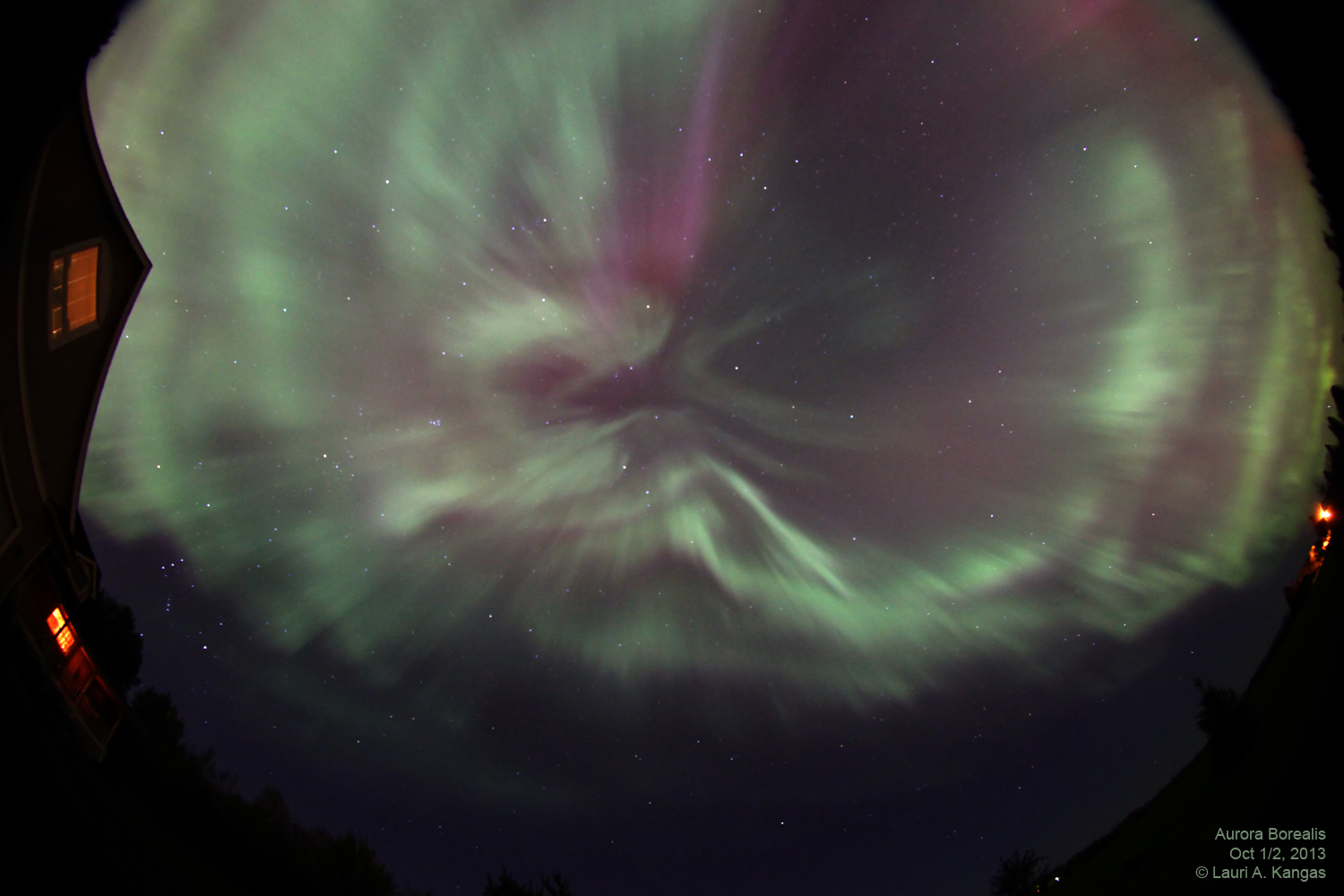
Aurora Borealis - October 1/2, 2013 Wow! These were the best Aurora that I have captured in Fort Frances to date. There may have been better displays here but it was either cloudy, hindered by a full moon or I was unable to image them due to family commitments. This was an amazingly animated display with undulating ribbons, fantastic corona formations and shimmering curtains of light. It started off rather innocuously with a green saucer shaped blob of green light in the SW sky and then it just erupted. Photos taken with a Canon 5D MKII with a 17mm lens and a Canon 7D with an 8mm fisheye lens.
Aurora Borealis - November 13/14, 2012 Late in the evening I noticed that the Kp index had reached 6. It had been severely overcast for most of the day and I thought that this would be a bust. Looking out our laundry room window I noticed a sliver of bright green to the north visible behind the clouds so I grabbed a couple of cameras and tripod and headed out. The clouds were persistent to the north where the brightest portion of the aurora were visible but the aurora were bright enough to produce a nice show. Photos taken with a Canon 5D MKII with a 17mm lens and a Canon 7D with an 8mm Sigma fisheye lens.
Aurora Borealis - October 13, 2012 What a wonderful night! It was the best night yet since moving to Fort Frances; there were no clouds and no bright moon to contend with. Although the Kp index reached only 5 it was a mesmerizing night with non-stop animated motion. I completely lost all track of time and was out from midnight to 4:30 a.m. and it seemed like a half an hour. The display covered most of the sky so I used a Sigma 8mm fisheye with a Canon 7D DSLR to capture the images. The skies were so bright at times that I did not need a flashlight to see on a moonless night on the banks of the Rainy River. I did have a ticked off beaver swimming semicircles around me in the river startling me with the loud slaps of his tail. I must have been in his favourite poplar tree territory! I had bear spray with me as we have seen bear and wolf tracks in the riverbank during the day. I eventually decided to pack it in when I heard a pack of yipping and howling coyotes getting closer to me.
Aurora Borealis - September 4, 2012 A moderate storm with the Kp index reaching 6 but the latter part of the display was washed out by a bright gibbous moon.
Aurora Borealis - June 17, 2012 This geomagnetic storm was expected. Sunspot AR1504 unleashed two consecutive flares whose combined impact produced a geomagnetic storm with a planetary K-index of 6. This display was particularly interesting as there were beautiful blue and purple colours in the display which from my experience are much more rare. Images taken with a Canon 5D Mark II DSLR with a 17-40mm zoom lens set at 17mm, f/4.
Aurora Borealis - May 9, 2012 and April 23, 2012
Aurora Borealis - March 9, 2012 This geomagnetic storm was expected. Sunspot AR1429A unleashed an X5-flare which hit Earth's magnetic field on March 8, 2012. The planetary K-index reached 7, which is a strong geomagnetic storm. The display was absolutely fascinating on this cold night with temperature falling to -20C. There were fluttering curtains of light, pulsating beams and flashes passing overhead and morphing shapes in the corona overhead. The bright full moon washed out the images somewhat; the display would have been even more impressive had it been a moonless night. Images were taken with a Canon 5D Mark II with a 17-40mm zoom lens set at 17mm, f/4.
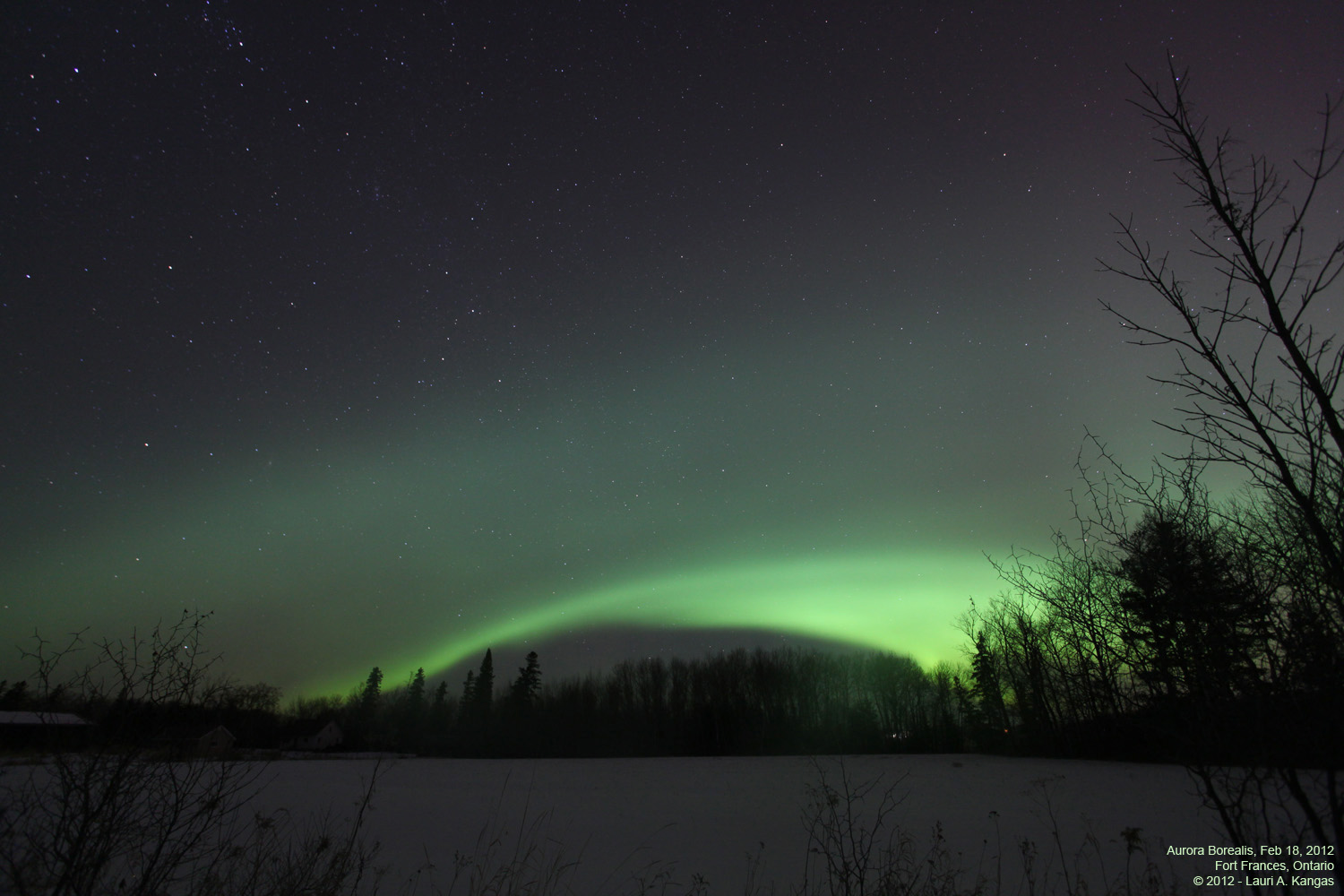
Aurora Borealis - February 18, 2012 This was an unexpected geomagnetic storm. Although the planetary K-index only reached 5, the display was quite intense with aurora scattered throughout the sky as far southwest as the constellation Orion. We witnessed the display from around 9:00 p.m. CST until after midnight. Images were taken with a Canon 40D DSLR with a Sigma 8mm f/3.5 fisheye lens and a Canon 5D Mark II with a 17-40mm zoom lens set at 17mm, f/4.
The images below of the Aurora Borealis were taken in Caledon, Ontario, which is located approximately 50 kilometers or 30 miles (as the crow flies) north of Toronto, Ontario, Canada. We don't live in igloos here, in fact the latitude here is equivalent to Monaco, Nice (France), Florence (Italy), Sarajevo (Bosnia and Herzegovina), Bucharest (Romania), Portland (Oregon), and Green Bay (Wisconsin). You don't necessarily have to be in the Arctic to see beautiful displays of Aurora Borealis, if the conditions are right and the Geomagnetic Storm is strong enough, you can get a great show at lower latitudes | ||||||||||||||||||||||||||||||||||||||||||||||||||||||||||||||||||||||||||||||||||||||||||||||
|
Aurora Borealis - October 24, 2011 After many years of Solar Minimum, Northern Lights from a strong geomagnetic storm created by a CME were finally visible in the Greater Toronto Area (as well as a large portion of Canada, the United States and Europe). There have been a few strong storms recently but cloud cover was prevalent in the Toronto area at those times. On the evening of October 24, 2011, when darkness fell, a uniform green glow was visible throughout the northern sky. The planetary K-Index was 5 and then jumped to 7 . Working on a hunch, I quickly set up the camera and tripod in the driveway. Within a few minutes at approximately 9:25 p.m. EDT the sky literally erupted into a red curtain of fluttering light rapidly growing towards the zenith. The brightest part of the eruption only lasted for about 10 minutes and then faded into a mild display of Northern Lights. The photos below were all taken within 15 minutes of each other during the peak of the storm. The colour red was predominant in this display and is associated with high altitude excitation of Oxygen atoms. All photos taken with a Canon 5D Mark II Digital SLR, lens set at 17mm, f/4.0, ISO ~1000, 8 to 12 second exposures.
| ||||||||||||||||||||||||||||||||||||||||||||||||||||||||||||||||||||||||||||||||||||||||||||||
|
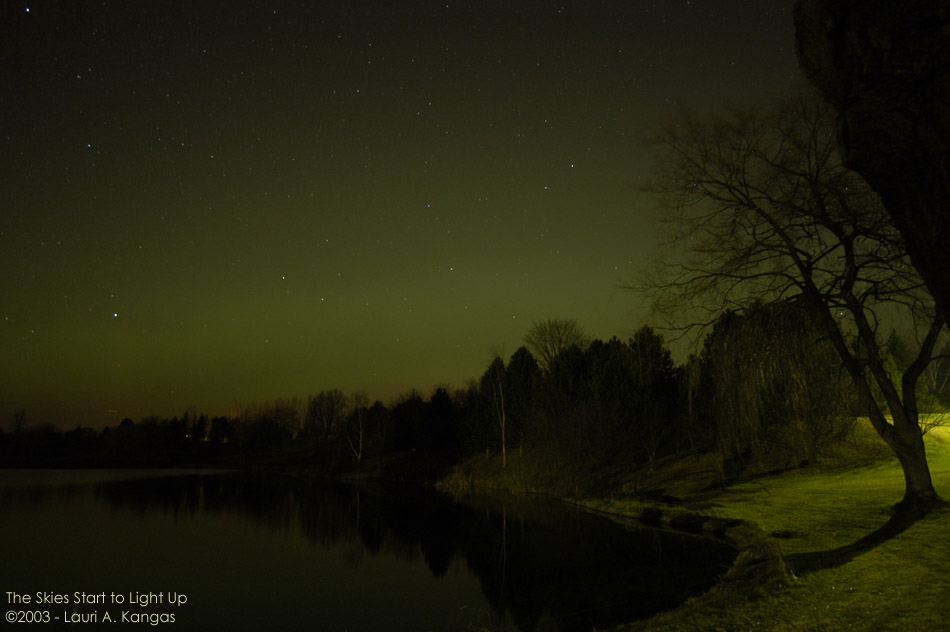
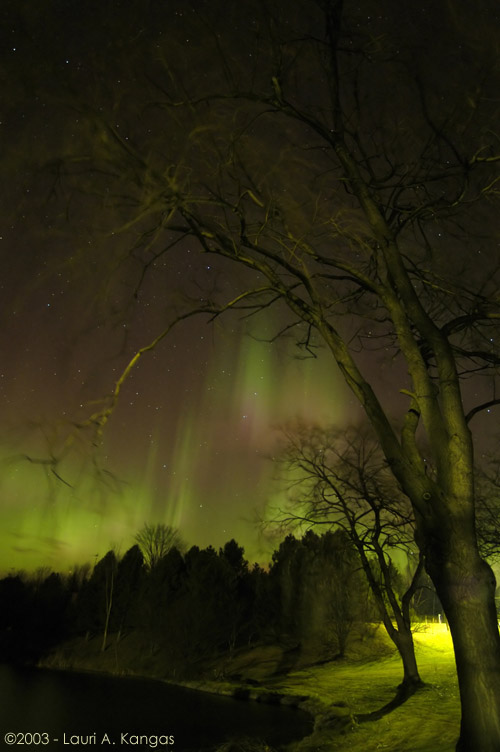
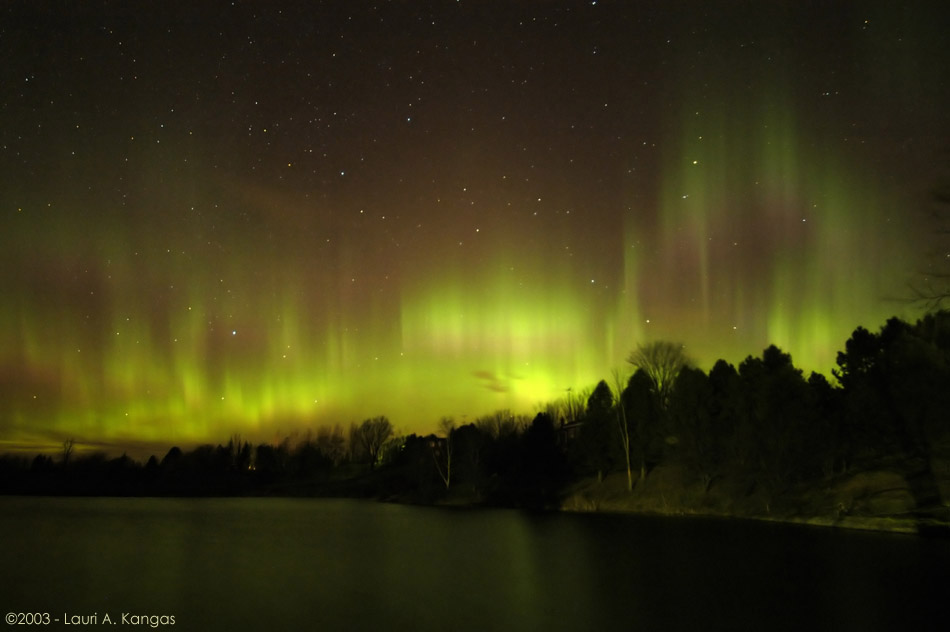
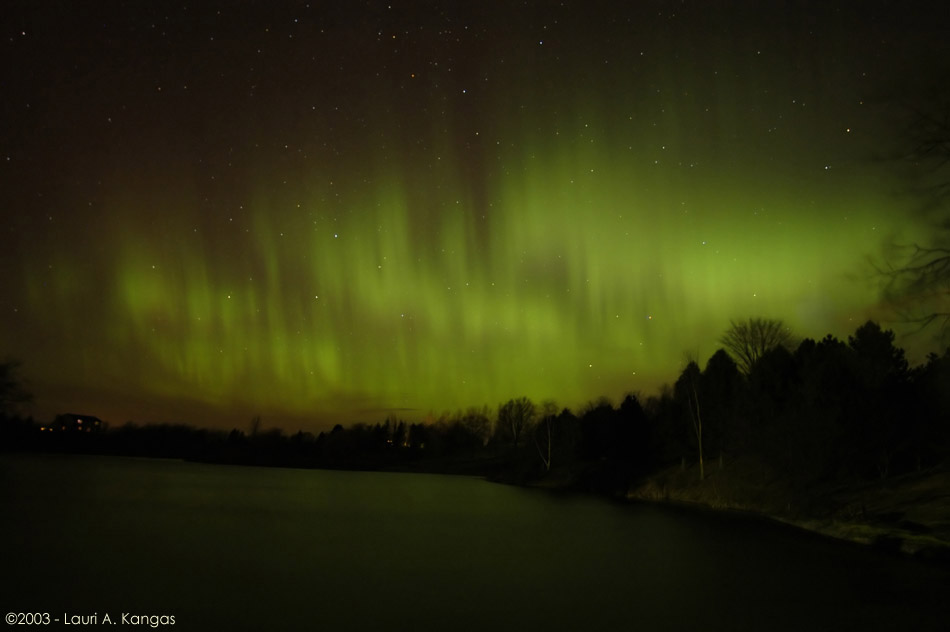
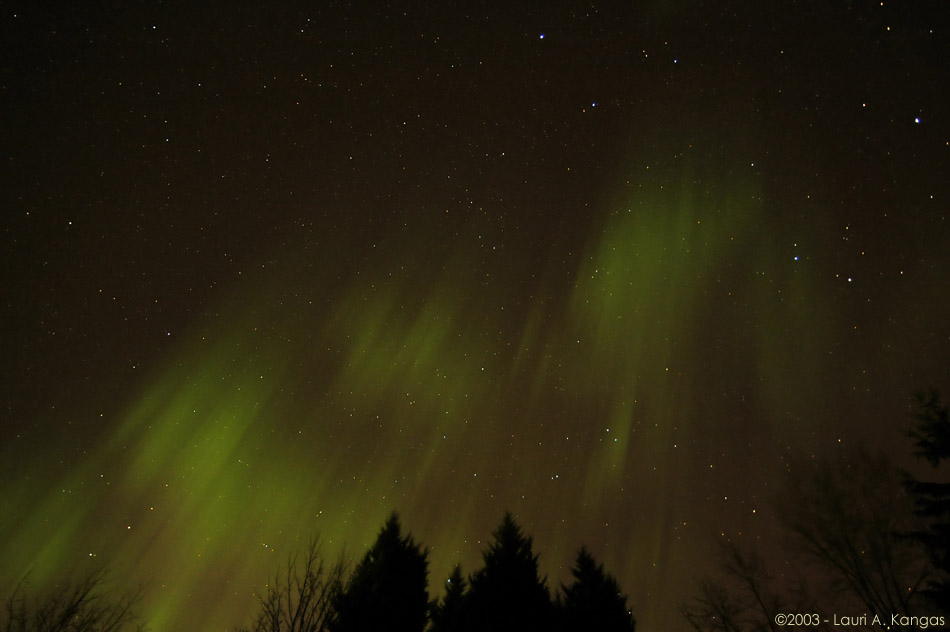
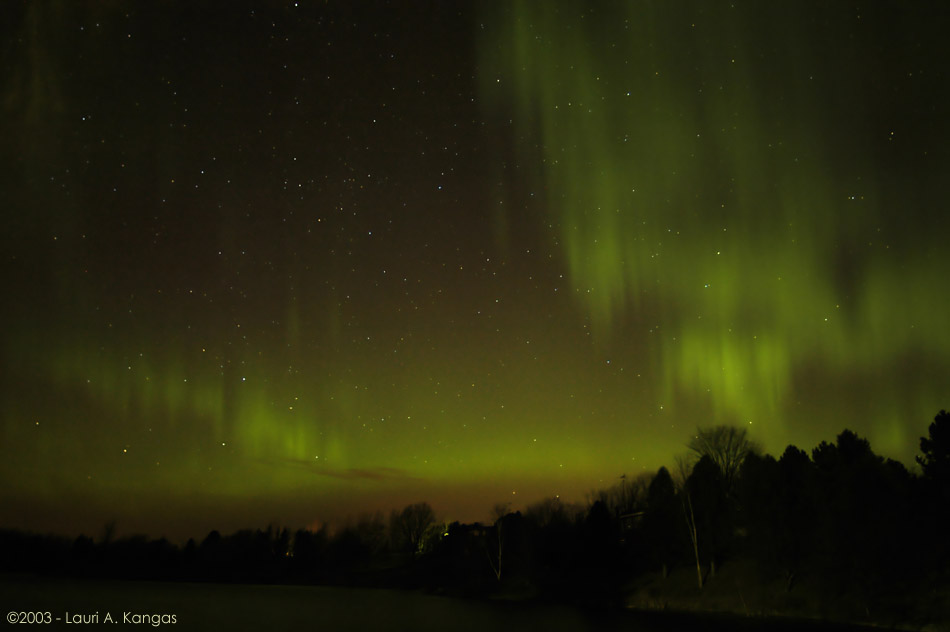
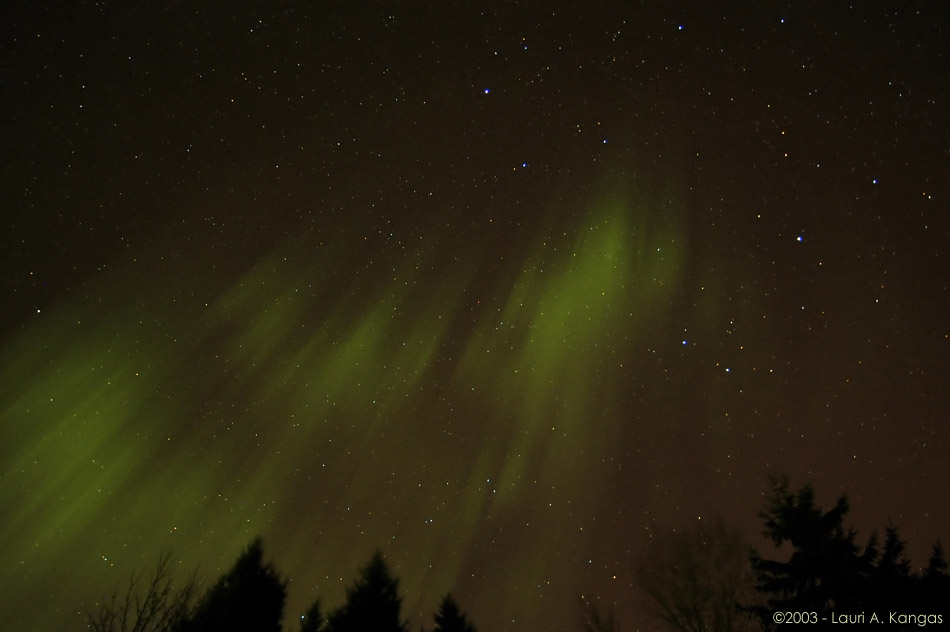
Aurora Borealis - November 20/21, 2003 Nikon D100 Digital SLR, 14mm lens (21mm effective focal length with the D100), f2.8, 25 second exposures at ISO 320
| ||||||||||||||||||||||||||||||||||||||||||||||||||||||||||||||||||||||||||||||||||||||||||||||
|
| ||||||||||||||||||||||||||||||||||||||||||||||||||||||||||||||||||||||||||||||||||||||||||||||
|
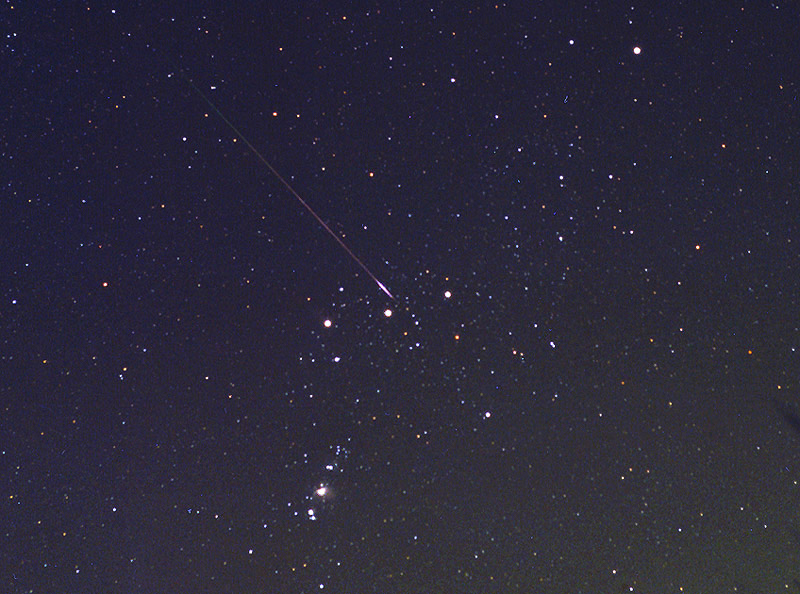
Aurora Oct 8, 2002 - (Nikon F2 35mm, 28mm lens, f2.8, 15 to 30 second exposures, Fuji Superia X-tra 800 Film)
|